publications
2026
-
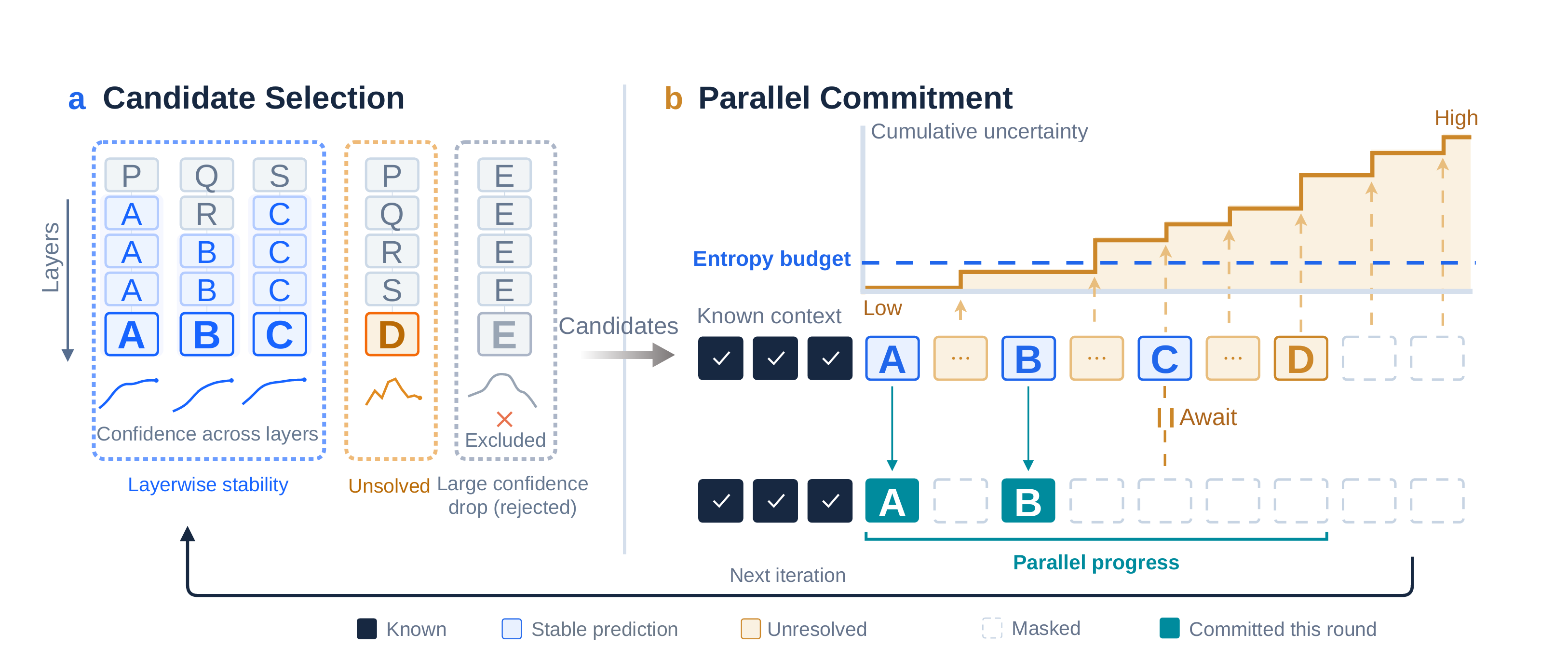 arXivReliable Parallel Decoding in Masked Diffusion Language ModelsZhenghao He , Bohan Liu , Guangzhi Xiong , and 1 more authorIn arXiv preprint (arXiv) , 2026
Masked diffusion language models (MDLMs) can generate text efficiently by predicting multiple masked tokens in parallel, but predictions from the same forward pass are not necessarily reliable when committed together. We study when parallel commitment is reliable. Our diagnostics show that confidence alone does not determine a reliable commitment order: confident predictions near the end of the sequence can fix an answer before its supporting computations are established, and downstream predictions become less reliable as the uncertainty of their upstream context grows. At the same time, a single forward pass can already resolve several masked tokens, and predictions that remain stable across the final layers are more likely to be correct. Based on these findings, we propose Reliable Parallel Decoding (RPD), a training-free method that selects candidates by layerwise prediction stability and final confidence, and commits them under a cumulative entropy budget over their preceding masked positions. RPD defers predictions with uncertain upstream context while committing the remaining candidates in parallel, without relying on a fixed block schedule. Across mathematical reasoning and code generation benchmarks on LLaDA and Dream, RPD achieves the highest decoding throughput among the evaluated methods while maintaining or improving accuracy.
-
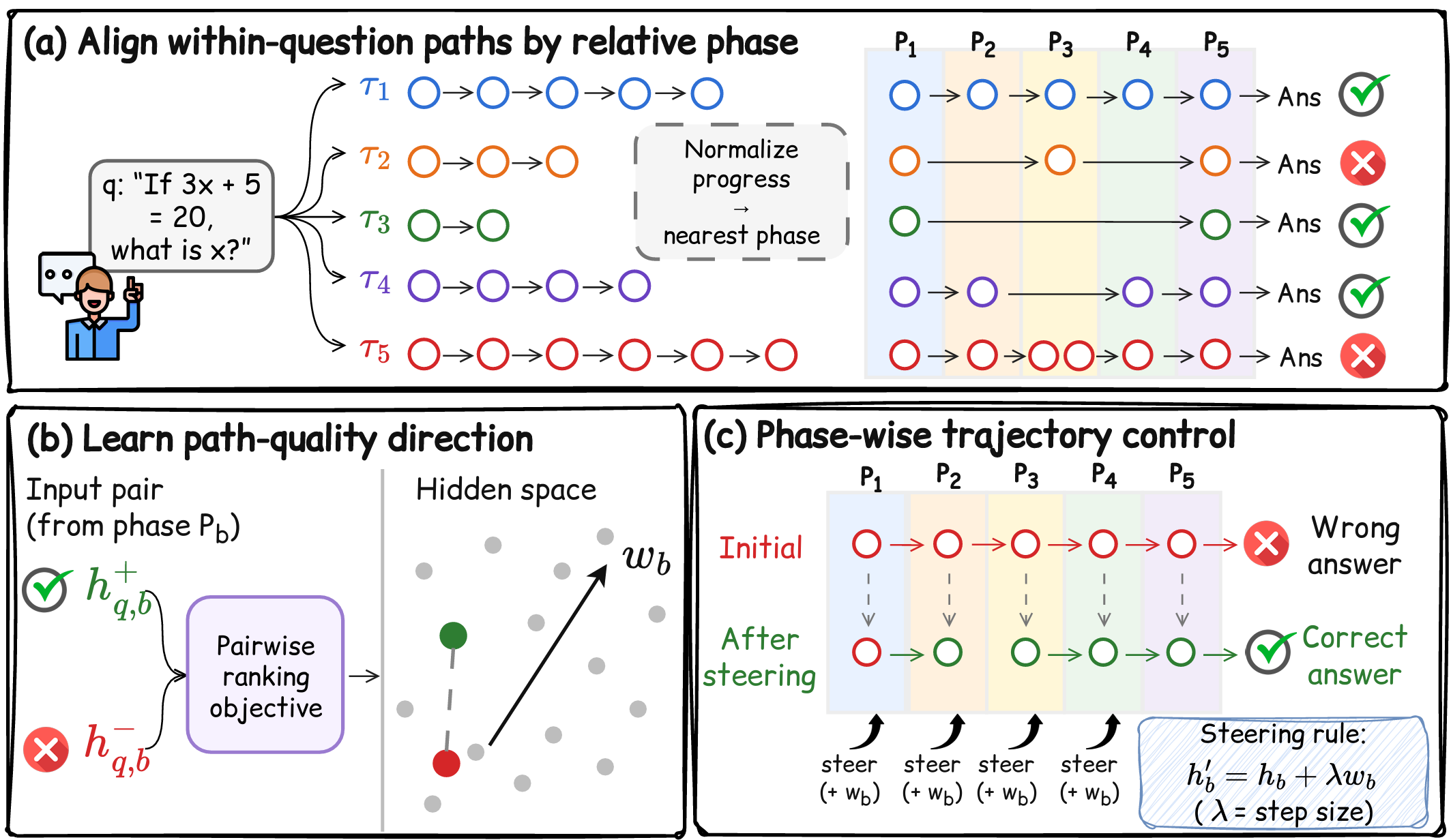 arXivRethinking Reasoning Paths as Phase-Structured TrajectoriesZhenghao He , Guangzhi Xiong , Sanchit Sinha , and 3 more authorsIn arXiv preprint (arXiv) , 2026
Large language models often improve problem-solving performance by generating multi-step reasoning paths, yet how to analyze the hidden states along these paths remains unclear. Existing approaches typically assign each intermediate state the final-answer correctness label and train probes across heterogeneous questions. We argue that this protocol obscures reasoning dynamics in two ways: (1) correctness prediction can exploit question-level variation rather than path quality, and (2) states aligned by absolute step indices may correspond to different functional phases of reasoning. In this work, we propose to view reasoning paths as phase-structured trajectories within fixed questions. We instantiate this view as PAIR, short for Phase-Aligned Intra-question Reasoning. PAIR samples multiple trajectories for each question, maps variable-length paths into shared relative phases based on normalized trajectory progress, and compares successful and unsuccessful trajectories only within the same question and phase. This yields phase-specific path-quality directions that better isolate path-quality signals from question-level variation. Empirically, we find that standard across-question correctness probes lose much of their predictive power under within-question evaluation, suggesting that these probes partly rely on question-level information. PAIR improves within-question trajectory ranking and Best-of-N trajectory selection across models and benchmarks. Phase-wise steering further shows that the learned directions can change generation outcomes, providing causal evidence that they capture trajectory-relevant information.
-
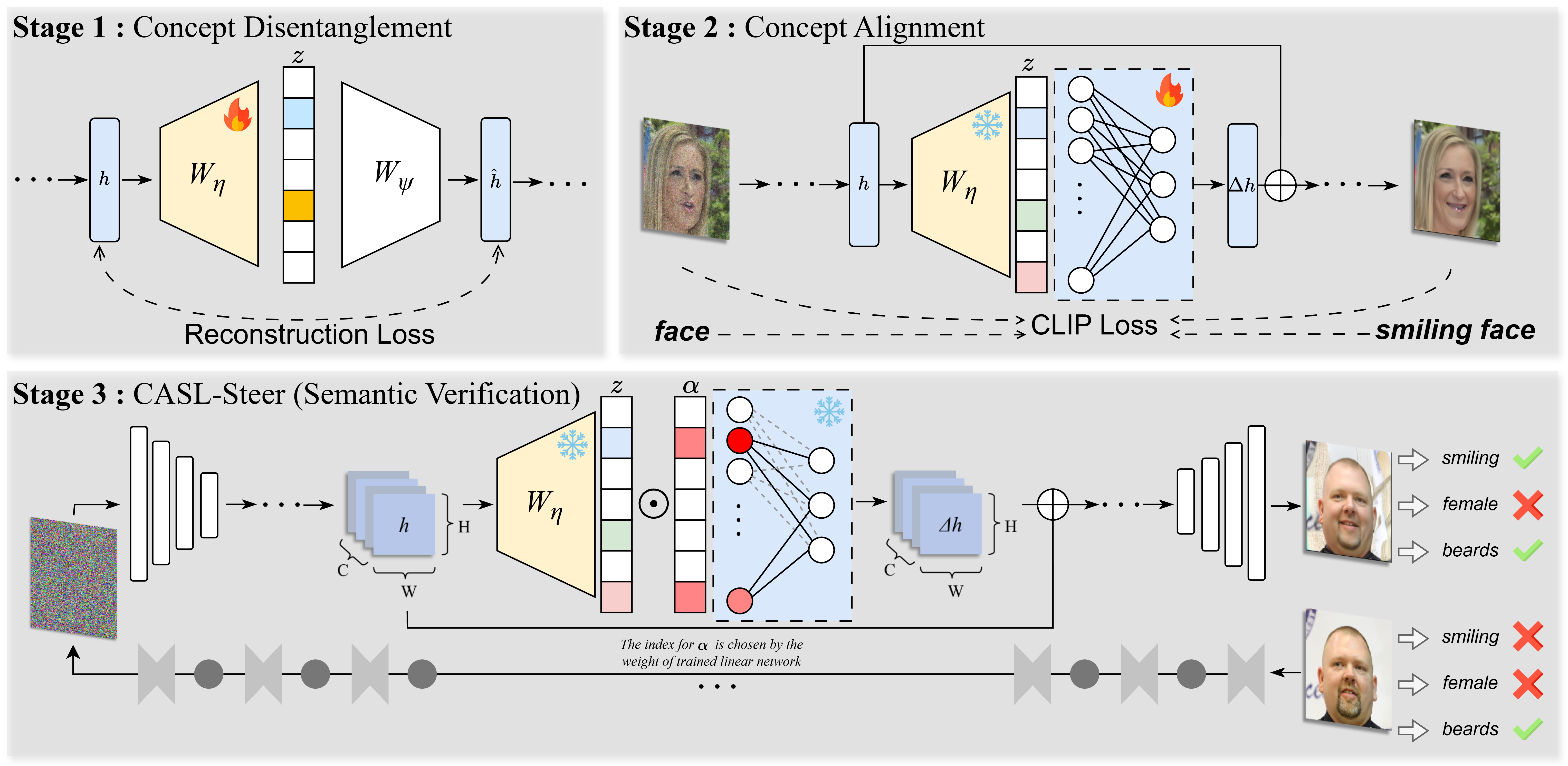 NeurIPSCASL: Concept-Aligned Sparse Latents for Interpreting Diffusion ModelsZhenghao He , Guangzhi Xiong , Boyang Wang , and 2 more authorsIn The Fortieth Annual Conference on Neural Information Processing Systems (NeurIPS) , 2026
Internal activations of diffusion models encode rich semantic information, but interpreting such representations remains challenging. While Sparse Autoencoders (SAEs) have shown promise in disentangling latent representations, existing SAE-based methods for diffusion model understanding rely on unsupervised approaches that fail to align sparse features with human-understandable concepts. This limits their ability to provide reliable semantic control over generated images. We introduce CASL (Concept-Aligned Sparse Latents), a supervised framework that aligns sparse latent dimensions of diffusion models with semantic concepts. CASL first trains an SAE on frozen U-Net activations to obtain disentangled latent representations, and then learns a lightweight linear mapping that associates each concept with a small set of relevant latent dimensions. To validate the semantic meaning of these aligned directions, we propose CASL-Steer, a controlled latent intervention that shifts activations along the learned concept axis. Unlike editing methods, CASL-Steer is used solely as a causal probe to reveal how concept-aligned latents influence generated content. We further introduce the Editing Precision Ratio (EPR), a metric that jointly measures concept specificity and the preservation of unrelated attributes. Experiments show that our method achieves superior editing precision and interpretability compared to existing approaches. To the best of our knowledge, this is the first work to achieve supervised alignment between latent representations and semantic concepts in diffusion models.
-
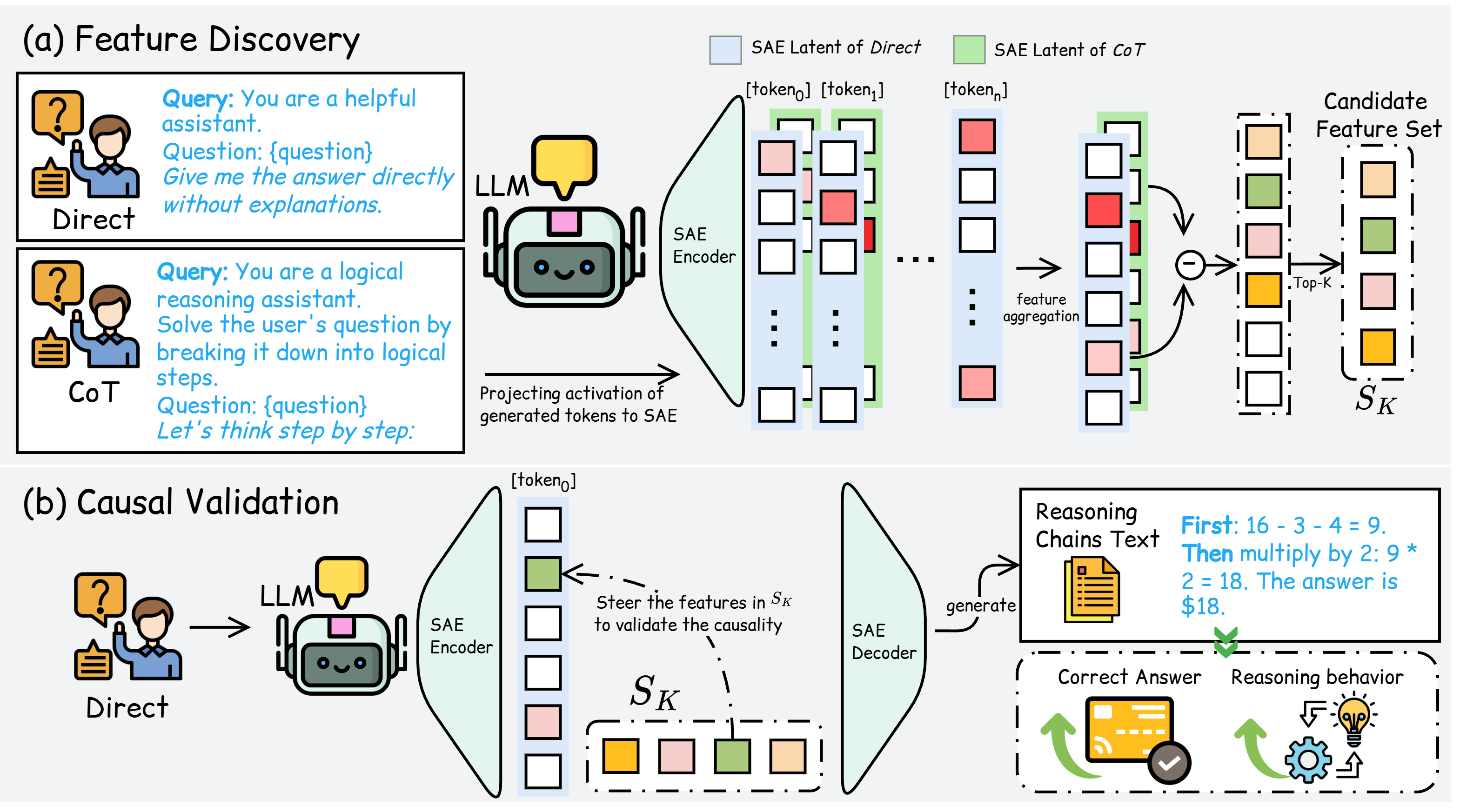 EMNLP MainTriggering Chain-of-Thought via Latent Feature Interventions in Large Language ModelsZhenghao He , Guangzhi Xiong , Bohan Liu , and 2 more authorsIn The 2026 Conference on Empirical Methods in Natural Language Processing (EMNLP Main) , 2026
Chain-of-Thought (CoT) prompting often improves the reasoning performance of large language models (LLMs), but the internal signal that triggers this behavior remains poorly understood. Leveraging the sparse features captured by Sparse Autoencoders (SAEs), we propose a systematic framework to analyze and intervene on the internal representations of LLMs, identifying a small set of latent features that are linked to reasoning behavior and can be causally tested through targeted intervention. Across multiple model families and reasoning benchmarks, we show that steering one or a small number of reasoning-related latent features can substantially induce reasoning behavior without explicit CoT prompting, achieving accuracy comparable to CoT. We further show that the identified features are not tied to particular wording patterns or verbosity, and confirm their causal role in reasoning through suppression experiments that impair performance even under CoT prompting. These results suggest that CoT prompting activates specific latent features to trigger reasoning, and that targeted intervention on these features offers an alternative pathway to elicit efficient reasoning behavior without explicit CoT prompting.
-
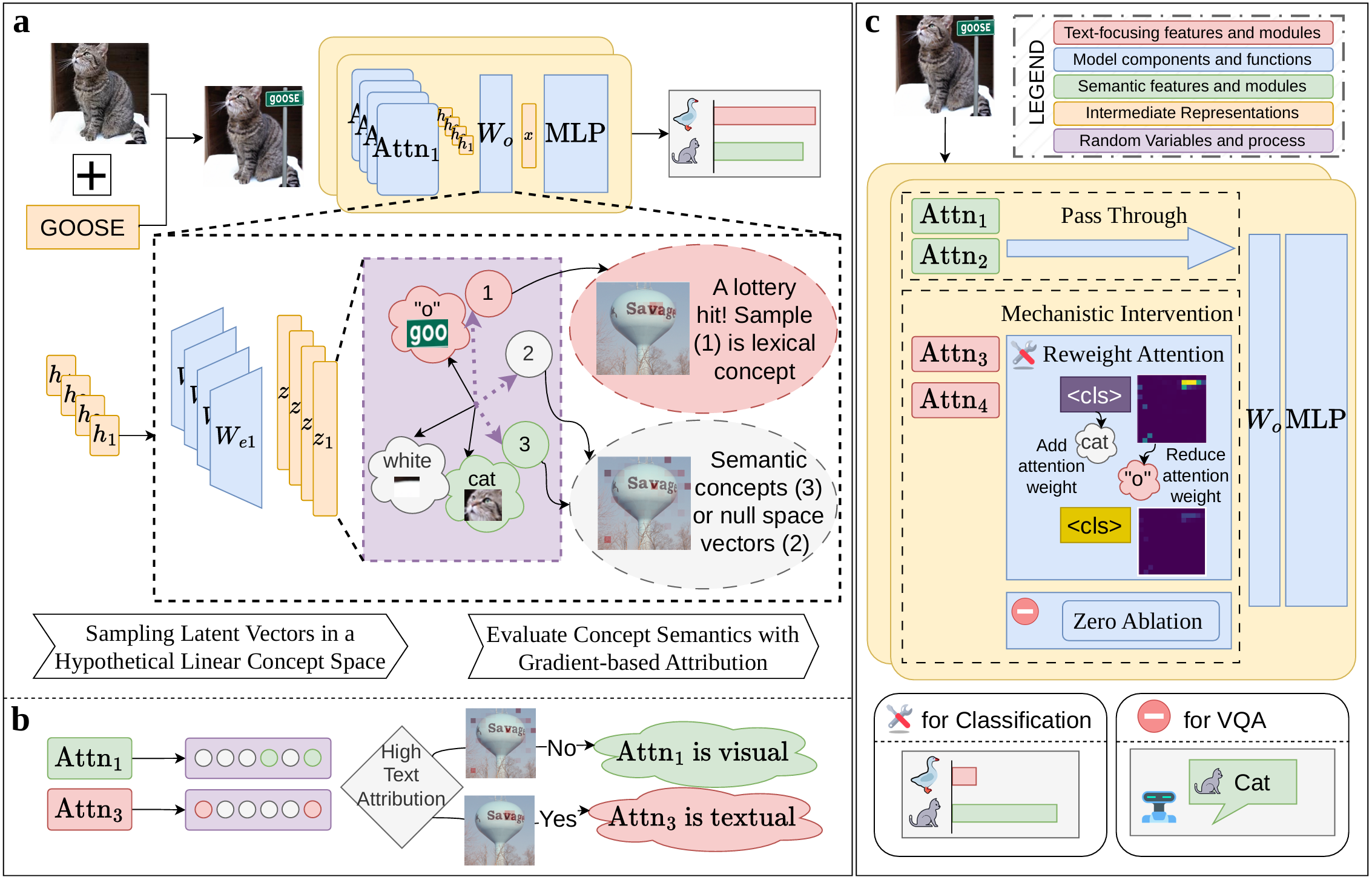 ECCVTowards Robustness against Typographic Attack with Training-free Concept LocalizationIn The 2026 Conference on Empirical Methods in Natural Language Processing (ECCV) , 2026
Models trained via Contrastive Language-Image Pretraining (CLIP) serve as the foundational vision encoders for most modern Large Vision Language Models (LVLMs). Despite their widespread adoption, CLIP models exhibit a critical yet underexplored failure mode: irrelevant text appearing within images confounds visual representations, biasing them toward lexical meaning rather than true visual semantics. This robustness issue, commonly described as a Typographic Attack (TA), exposes a vulnerability that poses a significant risk to safety-critical applications such as autonomous driving. To achieve interpretable and effective robustness against TA, we propose a novel, training-free mechanistic interpretability method. Our method provides sampling-based interpretations of hidden state representations and quantitatively attributes semantic versus lexical focus to individual attention heads. Through probabilistic analysis and circuit mining, we isolate specific Vision Transformer (ViT) components that disproportionately encode lexical information, thereby identifying the mechanistic source of TA. We further show that simple interventions applied directly to the identified circuits, without any additional training, can substantially improve robustness against Typographic Attacks in object classification. These interventions, such as selective adjustment of attention weights, also outperform both supervised and training-free defense methods. Our experiments demonstrate that applying the proposed intervention to the vision encoders of several state-of-the-art LVLMs yields substantial gains in Visual Question Answering accuracy under Typographic Attack interference on RIO-Bench. These results confirm both the efficacy and the generalizability of our mechanistic approach.
-
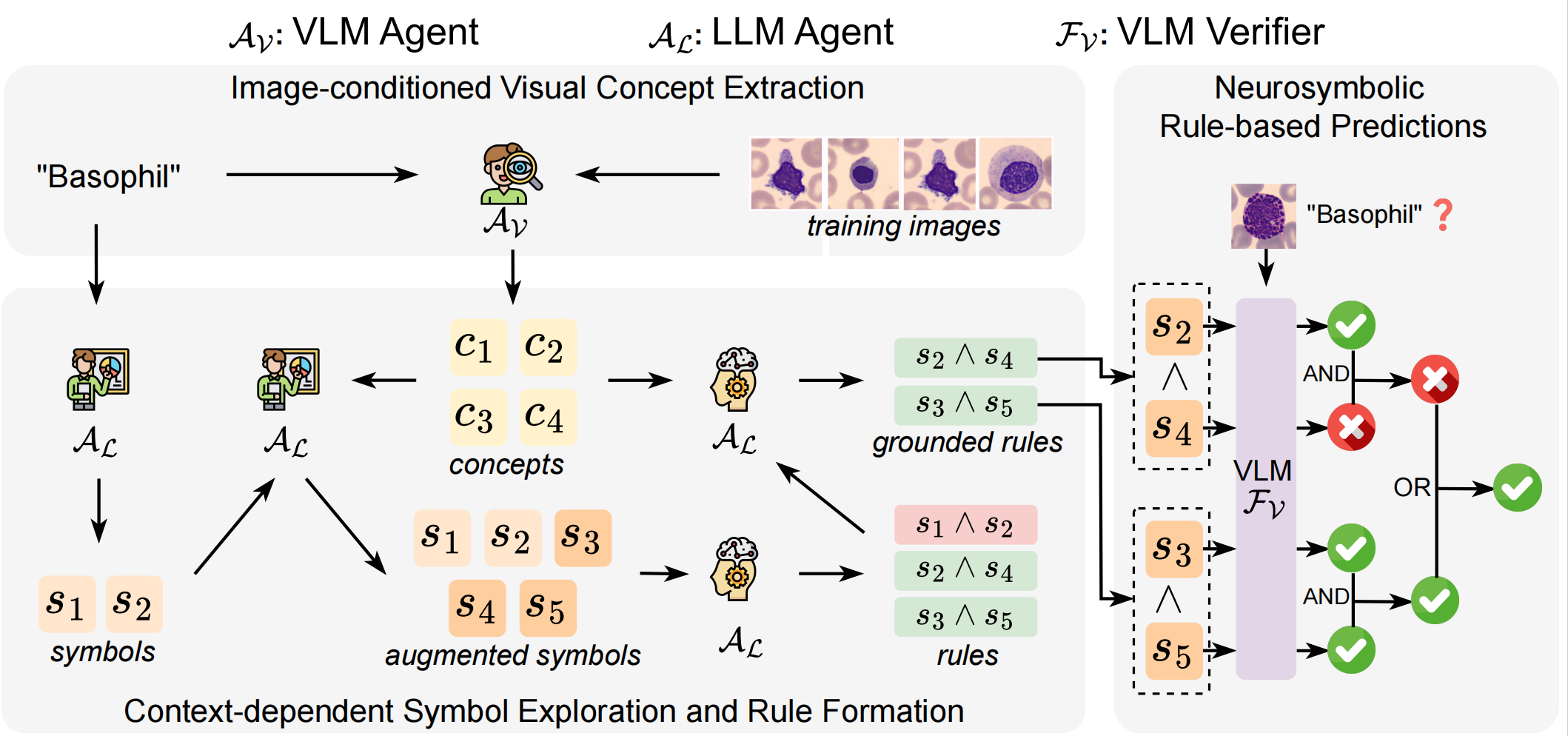 AAAIConcept-RuleNet: Grounded Multi-Agent Neurosymbolic Reasoning in Vision Language ModelsSanchit Sinha , Guangzhi Xiong , Zhenghao He , and 1 more authorIn Association for the Advancement of Artificial Intelligence (AAAI), Oral Presentation , 2026To appear
Modern vision-language models (VLMs) deliver impressive predictive accuracy yet offer little insight into ’why’ a decision is reached, frequently hallucinating facts, particularly when encountering out-of-distribution data. Neurosymbolic frameworks address this by pairing black-box perception with interpretable symbolic reasoning, but current methods extract their symbols solely from task labels, leaving them weakly grounded in the underlying visual data. In this paper, we introduce a multi-agent system - Concept-RuleNet that reinstates visual grounding while retaining transparent reasoning. Specifically, a multimodal concept generator first mines discriminative visual concepts directly from a representative subset of training images. Next, these visual concepts are utilized to condition symbol discovery, anchoring the generations in real image statistics and mitigating label bias. Subsequently, symbols are composed into executable first-order rules by a large language model reasoner agent - yielding interpretable neurosymbolic rules. Finally, during inference, a vision verifier agent quantifies the degree of presence of each symbol and triggers rule execution in tandem with outputs of black-box neural models, predictions with explicit reasoning pathways. Experiments on five benchmarks, including two challenging medical-imaging tasks and three underrepresented natural-image datasets, show that our system augments state-of-the-art neurosymbolic baselines by an average of 5% while also reducing the occurrence of hallucinated symbols in rules by up to 50%.
-
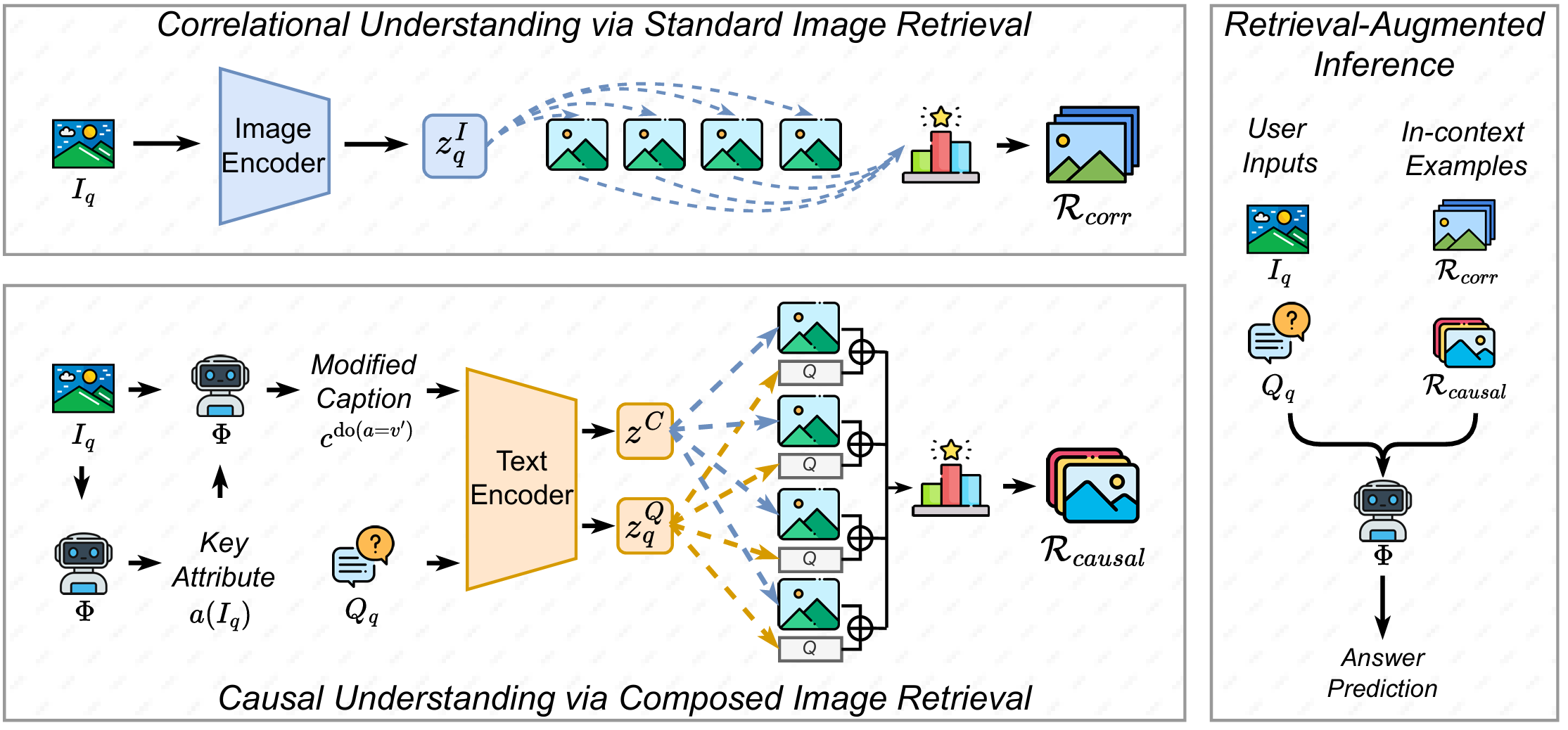 CVPRRetrieving Counterfactuals Improves Visual In-Context LearningIn International Conference on Learning Representations (CVPR) , 2026To appear
Vision-language models (VLMs) have achieved impressive performance across a wide range of multimodal reasoning tasks, but they often struggle to disentangle fine-grained visual attributes and reason about underlying causal relationships. In-context learning (ICL) offers a promising avenue for VLMs to adapt to new tasks, but its effectiveness critically depends on the selection of demonstration examples. Existing retrieval-augmented approaches typically rely on passive similarity-based retrieval, which tends to select correlated but non-causal examples, amplifying spurious associations and limiting model robustness. We introduce CIRCLES (Composed Image Retrieval for Causal Learning Example Selection), a novel framework that actively constructs demonstration sets by retrieving counterfactual-style examples through targeted, attribute-guided composed image retrieval. By incorporating counterfactual-style examples, CIRCLES enables VLMs to implicitly reason about the causal relations between attributes and outcomes, moving beyond superficial correlations and fostering more robust and grounded reasoning. Comprehensive experiments on four diverse datasets demonstrate that CIRCLES consistently outperforms existing methods across multiple architectures, especially on small-scale models, with pronounced gains under information scarcity. Furthermore, CIRCLES retrieves more diverse and causally informative examples, providing qualitative insights into how models leverage in-context demonstrations for improved reasoning.
-
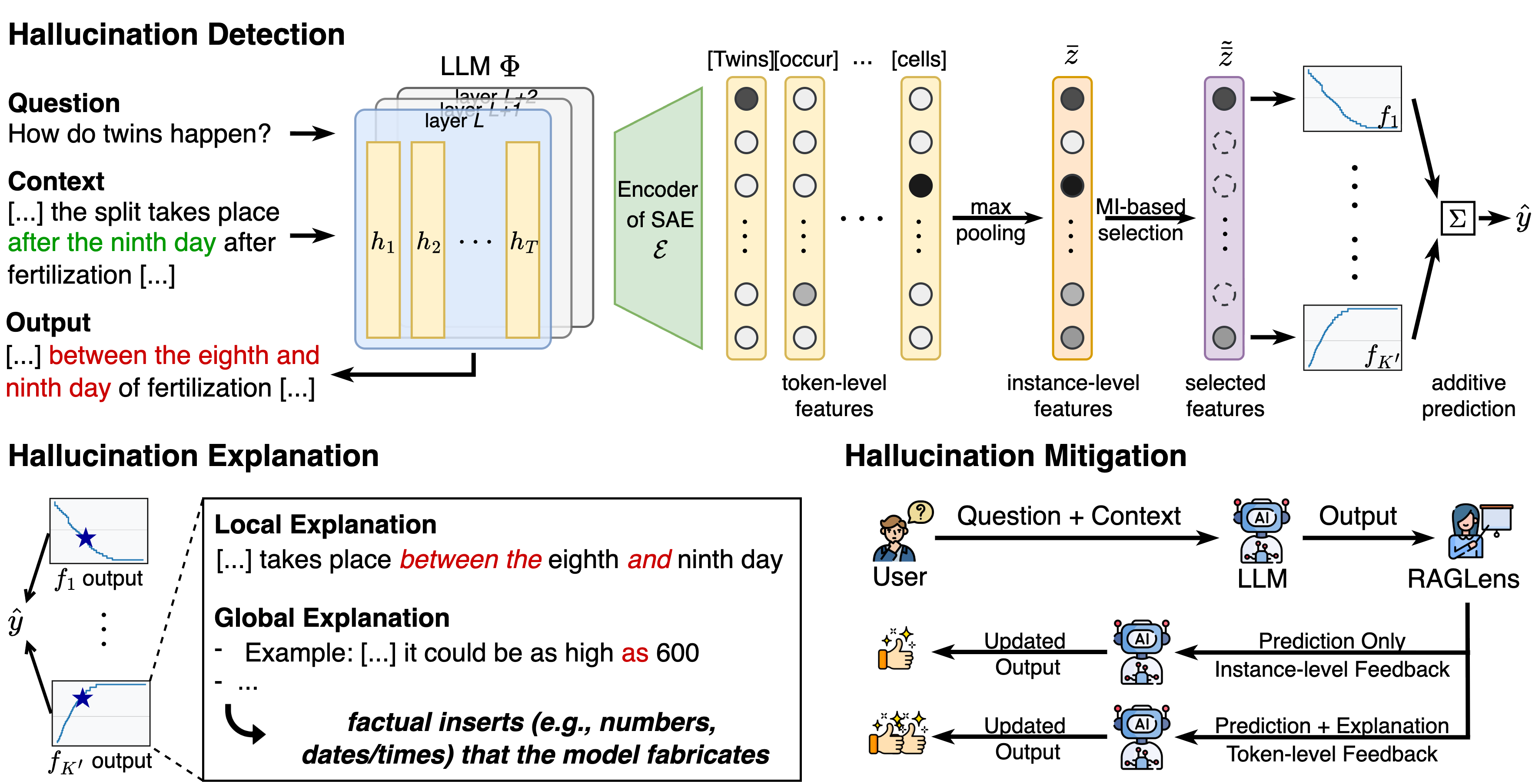 ICLRToward Faithful Retrieval-Augmented Generation with Sparse AutoencodersGuangzhi Xiong , Zhenghao He , Bohan Liu , and 2 more authorsIn International Conference on Learning Representations (ICLR) , 2026To appear
Retrieval-Augmented Generation (RAG) improves the factuality of large language models (LLMs) by grounding outputs in retrieved evidence, but faithfulness failures, where generations contradict or extend beyond the provided sources, remain a critical challenge. Existing hallucination detection methods for RAG often rely either on large-scale detector training, which requires substantial annotated data, or on querying external LLM judges, which leads to high inference costs. Although some approaches attempt to leverage internal representations of LLMs for hallucination detection, their accuracy remains limited. Motivated by recent advances in mechanistic interpretability, we employ sparse autoencoders (SAEs) to disentangle internal activations, successfully identifying features that are specifically triggered during RAG hallucinations. Building on a systematic pipeline of information-based feature selection and additive feature modeling, we introduce RAGLens, a lightweight hallucination detector that accurately flags unfaithful RAG outputs using LLM internal representations. RAGLens not only achieves superior detection performance compared to existing methods, but also provides interpretable rationales for its decisions, enabling effective post-hoc mitigation of unfaithful RAG. Finally, we justify our design choices and reveal new insights into the distribution of hallucination-related signals within LLMs.
2025
-
 ICCVGCAV: A Global Concept Activation Vector Framework for Cross-Layer Consistency in InterpretabilityZhenghao He , Sanchit Sinha , Guangzhi Xiong , and 1 more authorIn Proceedings of the IEEE/CVF International Conference on Computer Vision (ICCV) , 2025
Concept Activation Vectors (CAVs) provide a powerful approach for interpreting deep neural networks by quantifying their sensitivity to human-defined concepts. However, when computed independently at different layers, CAVs often exhibit inconsistencies, making cross-layer comparisons unreliable. To address this issue, we propose the Global Concept Activation Vector (GCAV), a novel framework that unifies CAVs into a single, semantically consistent representation. Our method leverages contrastive learning to align concept representations across layers and employs an attention-based fusion mechanism to construct a globally integrated CAV. By doing so, our method significantly reduces the variance in TCAV scores while preserving concept relevance, ensuring more stable and reliable concept attributions. To evaluate the effectiveness of GCAV, we introduce Testing with Global Concept Activation Vectors (TGCAV) as a method to apply TCAV to GCAV-based representations. We conduct extensive experiments on multiple deep neural networks, demonstrating that our method effectively mitigates concept inconsistency across layers, enhances concept localization, and improves robustness against adversarial perturbations. By integrating cross-layer information into a coherent framework, our method offers a more comprehensive and interpretable understanding of how deep learning models encode human-defined concepts.